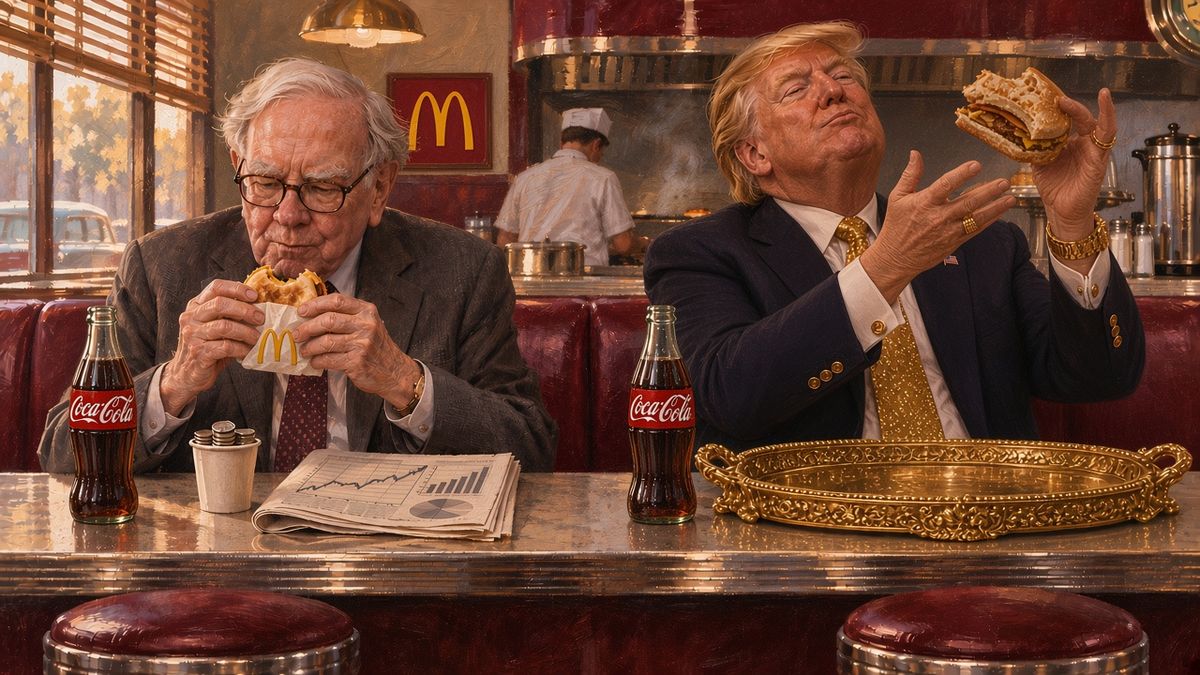
In 2017, one of the richest men on the planet explained to a documentary crew how he decides what to eat for breakfast. Every morning, while shaving, Warren Buffett told his wife one of three numbers: $2.61, $2.95 or $3.17. She put the exact change in a cup in the car. On his five-minute drive to the office in Omaha he stopped at McDonald's, and the stock market chose the menu. A good day on Wall Street meant a bacon, egg and cheese biscuit for $3.17. A bad day meant two sausage patties for $2.61 (Money).
The man ordering is worth around $145 billion today, according to Fortune. McDonald's had even given him a rare Gold Card for free food for life in Omaha. He paid anyway (GOBankingRates).
Another American billionaire is just as loyal to the Golden Arches. At a CNN town hall in 2016, Donald Trump explained that he likes cleanliness, and that a fast food chain feels safer than a place where you have no idea where the food comes from, because "it's a certain standard" (Fortune).
Humans are very good at telling stories about other humans, and marketers are no exception. Here is the story many companies would write about these two customers:
Male, over 70, American, billionaire. Regular McDonald's customer, often orders breakfast. Loyal to the brand for decades.
On paper, this is one person. In reality it is two very different minds that happen to queue at the same counter, and a campaign written for this card would speak to neither of them.
What is a buyer persona, and why is it no longer enough?
A buyer persona is a research-based profile that represents a segment of your target audience (HubSpot). It is written as if the segment were one person, with a name, a story, what they want, what stops them and how they decide.
A target market is a broad group described by demographics, such as "women aged 35 to 45, in urban areas, who love yoga". A buyer persona is one specific person inside that group (Shopify). It gives marketing, sales and product teams the same customer to keep in mind when they make decisions.
That was a useful step: it got teams to picture a person instead of a spreadsheet. But most guides stop at how to fill one in, and this article starts where they stop. A persona built on who the customer is on paper cannot tell apart people who buy for opposite reasons, and it says nothing about the places where they buy. At HCG we have replaced it with two layers: human-centric segments and tribes.
Why Buffett and Trump would get the same buyer persona
Age, gender, nationality, wealth, favorite brand, purchase frequency: on every field of a typical persona card, Buffett and Trump match. They differ on the field most teams fill in last, if at all: the reason.
That is the limit of a buyer persona built on demographics and behavior. It describes a person's situation and what they do, and it leaves out why they choose. The why decides which message works, which price holds and what would make the customer leave.
A quick test for any persona: if two customers who buy for opposite reasons both fit your card, it is a demographic card. You are probably describing two people as if they were one.
Buffett vs Trump: same buyer persona, two different segments
We look at both men only as consumers: what they buy and the reasons they, or people close to them, have given. Seen this way, they turn out to live by two different rules.
Warren Buffett behaves as if every dollar has to justify its existence. He still lives in the Omaha house he bought in 1958 for $31,500 (GOBankingRates). He drove a 2006 Cadillac for eight years and only 19,000 miles. When it finally had to go, in 2014, he sent his daughter Susie to buy the replacement, and she later revealed in a BBC documentary that her father liked cars with hail damage, because they cost less (Benzinga).
Even his one great extravagance came with a confession attached. After years of arguing against corporate jets, he bought a used Falcon 20 in 1986 for $850,000, then another used jet in 1989 for $6.7 million. He and Charlie Munger named it "The Indefensible" (Quartz). The name later changed to "The Indispensable", once the plane had proved its worth in saved time, yet in 2012 Buffett still called it "the only thing that I do that costs a lot of money" (CNBC). Few billionaires feel the need to apologize to their own aircraft.
Donald Trump lives by the opposite rule: success should be seen. From 1983 to 2019 his main home was the penthouse at the top of Trump Tower (Wikipedia), known for gilded mouldings, marble, crystal chandeliers and painted ceilings in the style of Louis XIV (Arch2O). In 2019 he made Mar-a-Lago, his private club in Palm Beach, his permanent residence (NPR). His Boeing 757, Trump Force One, came with a private bedroom and gold-plated seatbelts (Business Insider), and his name runs along the black fuselage in gold letters (SlashGear). Buffett treats money as something to account for. Trump treats it as something to display.
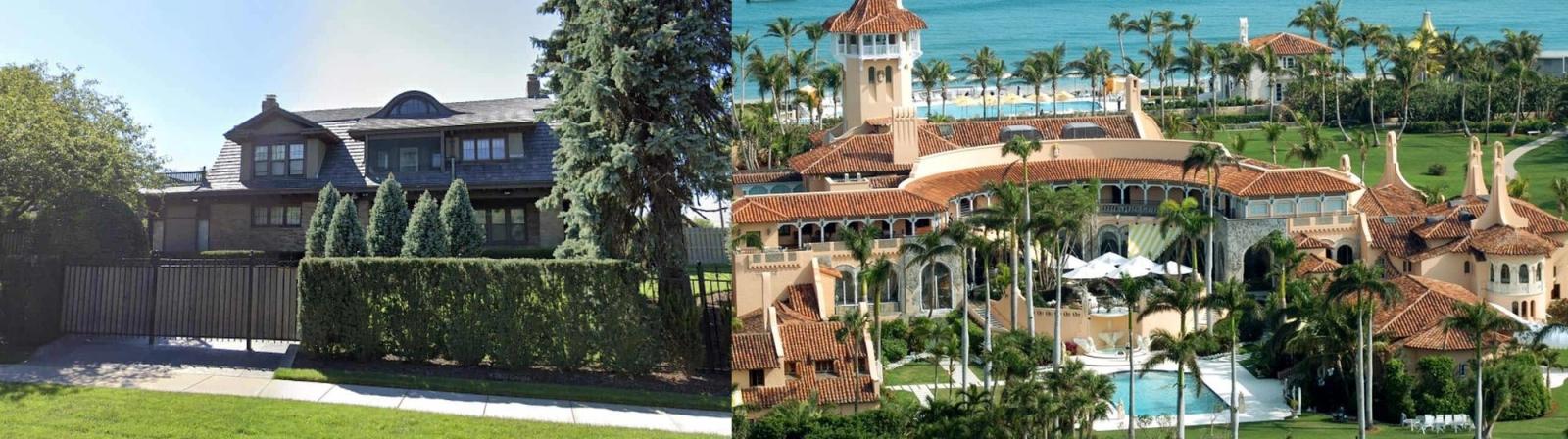
Two billionaires, two homes: the Omaha house Warren Buffett bought in 1958, and Mar-a-Lago, Donald Trump's permanent residence since 2019.
And yet the two men end up in the same queue. Buffett seems to go for value and for a daily ritual he controls down to the cent. Trump goes because a global chain promises that the burger in one city will be the burger in every other city. Same product, same price, and two reasons that have almost nothing in common.
Side by side:
- Home. Buffett: the Omaha house bought in 1958 for $31,500. Trump: the gilded Trump Tower penthouse, then Mar-a-Lago in Palm Beach.
- Getting around. Buffett: a 2014 Cadillac bought with hail damage. Trump: a Boeing 757 with gold-plated seatbelts and his name on the fuselage.
- The splurge. Buffett: a used jet he nicknamed "The Indefensible". Trump: gold as a signature, from his home to his plane.
- Breakfast. Buffett: McDonald's, $2.61 to $3.17 depending on the market. Trump: McDonald's, for a standard he trusts.
- What the money has to buy. Buffett: a reason he can explain. Trump: visible success, and no surprises on the plate.
- A message that would work. Buffett: "Worth every cent". Trump: "The best, and always the same".
Two billionaires order from the cheapest menu in town for opposite reasons. Price alone tells you very little about who your customer is.
In our language, Buffett and Trump belong to two different segments. One is driven by control and by value he can explain. The other is driven by recognition, with a strong need for certainty. One persona card, two segments.
The 5 limits of buyer personas
The Buffett and Trump case shows the problem in one example. In everyday work, it shows up in five ways.
- It starts from who the customer is on paper. Age, job, income and habits come first. The reason to buy comes last, if it comes at all.
- It is one invented person. A persona is a character the team writes. Nothing tells you how many real customers look like it, so you cannot tell whether it is worth a campaign.
- It is often written in a meeting. Motivations get guessed by the team, and customers themselves do not always give their real reasons. Trump says he chooses McDonald's for hygiene, while Michael Wolff wrote that he had a long-standing fear of being poisoned and liked that nobody knew he was coming (Business Insider). Motivations have to be inferred from many answers and behaviors read together.
- It ignores context. A persona describes a person in a vacuum. The same person can behave very differently depending on the place and the people around them, which is where tribes come in.
- It ages quietly. Once printed, a persona rarely gets updated, while markets move. We covered this in AI market research and dynamic segmentation.
At HCG we answer the first four problems with two layers, segments and tribes, and the fifth by measuring both again as the market changes. The persona, if a team likes it, comes at the very end, as the face of a segment we have measured.
Beyond the buyer persona: human-centric segmentation
At HCG, a segment is who you are: your life stage, your values, what you spend on and why. We build segments from what large samples of real people say and do, so each one has a size, a set of motivations and a profile we can read. In Italy, our model splits the population into sixteen segments (HCG).
We place the segments on the Human-Centric Map: a wheel of eight basic motives people bring to their choices, from Enjoyment and Vitality to Power, Recognition, Control, Security, Belonging and Consciousness. The vertical axis runs from modern to traditional, the horizontal one from other-focused to self-focused. Each sphere is a segment, and its position shows the motives that drive it.
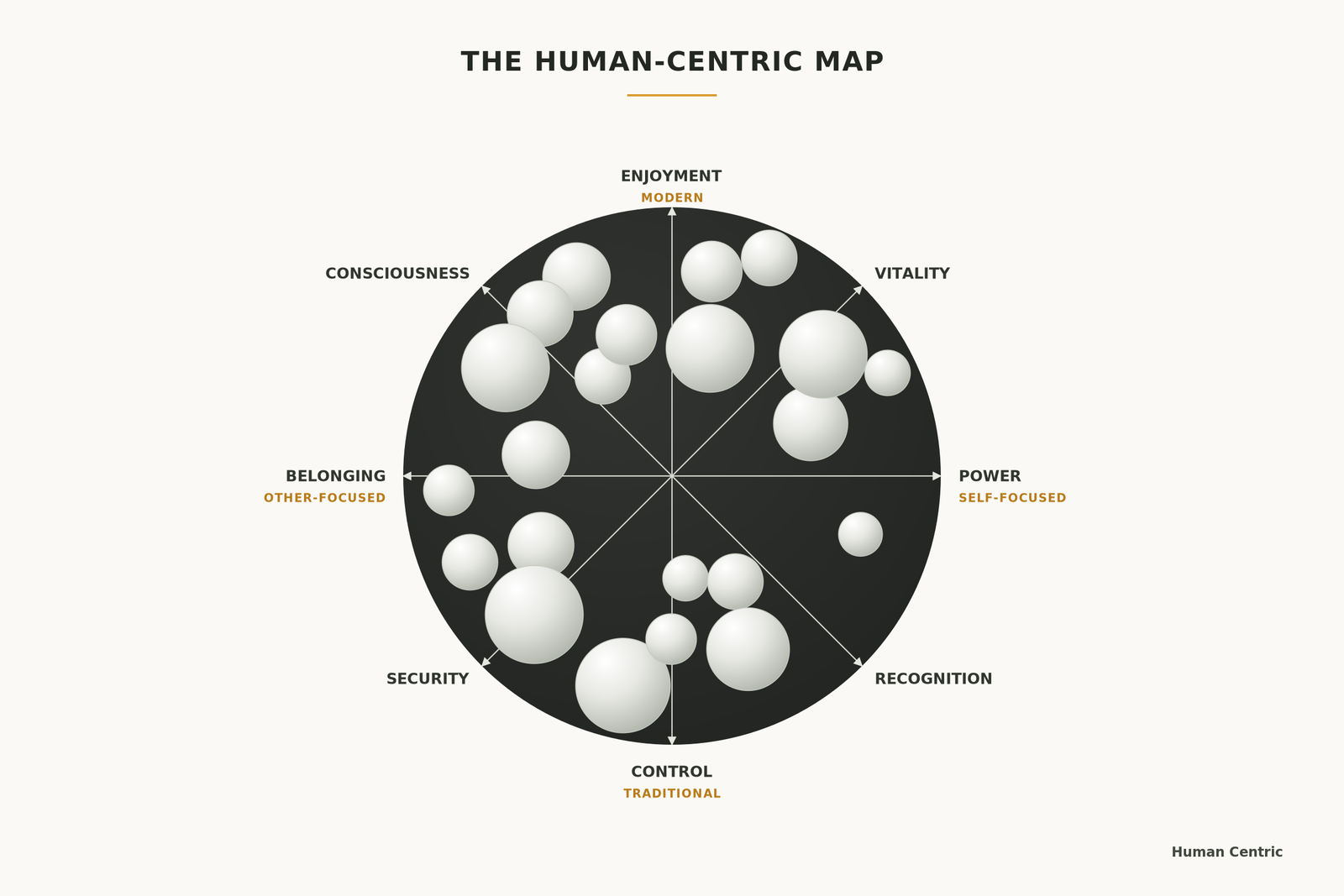
The Human-Centric Map: HCG's segments placed on eight basic motives.
Buffett and Trump would land in very different parts of the map. Buffett would sit in the lower, traditional half, close to Control. Trump would sit on the self-focused side, between Power and Recognition.
We read each segment with an index. We compare it with the average of all segments, not with the total population. An index above 120 means a trait is clearly over-represented, below 80 under-represented. Then we check the absolute share, because an index of 150 on a trait held by 2% of the segment does not define it.
A segment tells you who will buy and what will convince them. It still leaves one question open: where.
Tribes: where your customers recognize themselves
Long before marketing existed, humans organized themselves in tribes: groups held together by shared stories and shared rituals, more than by shared age or income. Consumers today are not so different.
If a segment is who you are, a tribe is where you recognize yourself. It is a community built around a place or a passion, with its own rituals, its own codes and usually a totem or two (HCG). Padel players, park runners, the regulars of a mountain refuge. People from very different segments meet there, and inside the tribe they follow the tribe's rules.
Our case on why KFC lasted five days in the Dolomites shows what happens when a brand forgets this. KFC picked a segment that loves it in the city, then walked into a mountain refuge as if it owned the place, and the mountain tribe pushed back. Segments tell you who will buy. Tribes tell you where a brand is welcome to sell.
Tribes also explain why the same product can mean different things. A 0.0 beer is bought by people who want control over their health and by people who want to stay part of the group on a night out: two segments. In a running tribe, the same bottle after the race can become a shared ritual for both. To choose which tribes a brand should join, we look at four things: aspirational power, purchase interest, shared values and growth momentum (HCG).
Buyer persona vs segment vs tribe: what changes
- The question it answers. Buyer persona: who is our typical customer? Segment: who will buy, and why? Tribe: where do they recognize themselves, and where is the brand welcome?
- What it is built on. Buyer persona: often the team's knowledge, a few interviews and CRM data. Segment: values, motivations and behaviors measured on a large sample. Tribe: places, passions, rituals and codes, read in data and in culture.
- Size. Buyer persona: unknown. Segment: known. Tribe: known, together with the segments that live in it.
- Who is inside. Buyer persona: one face that can cover opposite customers. Segment: people who share values and motivations. Tribe: different segments that share a place or a passion.
- What it gives the team. Buyer persona: someone to imagine. Segment: a message and a priority. Tribe: a context, its rules and the right way in.
Segment and tribe cards: what replaces the persona template
Instead of filling in yet another persona template, we work with two cards: one for the segment, one for the tribe.
The segment card. The examples show Buffett's and Trump's segments at McDonald's.
- Driving motivation. Why do they buy in this category? Buffett's segment: every dollar needs a reason. Trump's segment: certainty and visible success.
- What they want from the product. Buffett's segment: a good breakfast at a fair price, every day. Trump's segment: the same standard in every restaurant.
- What would make them leave. Buffett's segment: a price rise without a reason. Trump's segment: a food safety scare.
- The message that works. Buffett's segment: clear value, no waste. Trump's segment: you know exactly what you get.
- Size and index. How many people, and which traits stand out against the other segments. This comes from your data.
- Where to find them. Demographics, channels and media.
The tribe card. The example is the mountain tribe from our KFC case.
- Place or passion. The mountain, and the refuge in particular.
- Rituals and codes. The effort before the meal, local food, the quiet, the après-ski.
- Totems. The refuge itself.
- Segments inside. Creatives, Contributors, Liberals, Dolce Vitas, Go-Getters and Socialites: different ages, incomes and life stages.
- House rules for brands. Keep the logo off the totem, and ask before coming in.
- Aspirational power and growth. How much the tribe inspires people outside it, and whether it is growing or fading.
How to replace buyer personas with segments and tribes
- Keep your current personas as hypotheses. They tell you what the team believes about customers.
- Measure values and motivations on real people, with a survey large enough to compare groups, also across markets. Qualitative interviews help you find their language.
- Build the segments, read them with an index and size them.
- Map the tribes where your category lives: the places, passions and rituals that bring people together.
- Check which segments live in each tribe and which rules a brand has to respect there.
- Choose your segments and tribes, then add channels so media and sales teams can reach them.
- Give each segment a face, if the team finds it useful, and test the messages before scaling them.
Frequently asked questions
What are the limits of buyer personas?
A buyer persona starts from who the customer is on paper, describes one invented person of unknown size, often relies on motivations guessed in a meeting, ignores the context where people buy and ages quickly. That is why two customers who buy for opposite reasons can end up on the same card.
What is the difference between a buyer persona, a segment and a tribe?
A buyer persona describes one imagined customer. A segment is a measured group of real people who share values and motivations: who they are and why they buy. A tribe is a community built around a place or a passion, where people from different segments recognize themselves and follow shared rules.
Are buyer personas still useful?
Yes, as the face of a segment. They become risky when they replace the measurement, because one face can cover customers who buy for opposite reasons, as Warren Buffett and Donald Trump do at McDonald's.
What can replace buyer personas?
Two measured layers. Human-centric segments, groups of real people who share a life stage, values and motivations, each with a size and a profile. And tribes, communities built around a place or a passion, where different segments meet. The persona can stay, as the face of a measured segment.
How do you choose the right tribe for a brand?
Look at four things: how much the tribe inspires people outside it, whether it wants what the brand offers, whether its values match the brand's, and whether it is growing or fading.
Cover: AI-generated illustration.
About the author

Giacomo Tarabelli
Fuelled by curiosity and a passion for big ideas, Giacomo Tarabelli earned a BBA in London with a focus on Entrepreneurship, followed by a Master’s in International Management from Luiss. Throughout the academic journey, collaborations included global leaders such as Meta, Hermès, and Coca-Cola HBC.
The professional path began in Strategic Marketing at Human Centric Group, under the mentorship of Professor Matteo Rinaldi, evolving into a consultancy role across diverse industries. Experience ranges from crafting marketing strategies for FMCG giants like Carlsberg to supporting the growth of family-owned aviation companies such as Tecnam.
Guided by Einstein’s philosophy, “I am neither clever nor especially gifted. I am only very, very curious.”
Other sources
- Fortune, Warren Buffett steps down with a $145 billion net worth (2026)
- Money, 5 things from the documentary Becoming Warren Buffett
- GOBankingRates via Yahoo Finance, Warren Buffett buys his McDonald's based on the stock market
- Fortune, Donald Trump on fast food at the CNN town hall (2016)
- HubSpot, How to create detailed buyer personas for your business
- Shopify, What is a buyer persona
- Benzinga via AOL, Warren Buffett drives a 2014 Cadillac bought with hail damage
- Quartz, Warren Buffett never spent money like one of the richest people on Earth
- CNBC, How Warren Buffett spends his billions (2020)
- Wikipedia, Trump Tower penthouse of Donald Trump
- Arch2O, Inside Donald Trump's house and penthouse
- NPR, President Trump is a New Yorker no longer (2019)
- Business Insider via Yahoo, Inside Trump's Boeing 757 private jet
- SlashGear, A look at Donald Trump's private jet
- Business Insider, Michael Wolff on Trump and McDonald's (2018)