Private label now accounts for 43% of grocery sales by value across Europe's six largest markets, and around half of volumes (Circana, first half of 2026). In Italy its share is lower, around 30%, but it keeps climbing. Despar Nord already sells almost one product in three under its own brand, and the Despar group aims to pass 30% in all its companies within three years.
The useful question for a brand is no longer whether private label takes its customers. It already does. The question is which customers, and why.
Why does private label keep growing?
Store brands used to gain share when prices rose. Not anymore. In Italy, functional store-brand products grew 19% in 2025 (Rapporto Marca, Circana). In a survey by Istituto Piepoli, 61% of Italians say they have permanently replaced a known brand with a store-brand product. In GWI data, 62% of Italians online say they buy private label often or regularly; only 5% rarely or never do.
Who really chooses private label?
Store brands are no longer the choice of those who spend the least. In Italy, the heaviest buyers are older, traditional shoppers, and the most committed of them are the ones who ask brands for values.
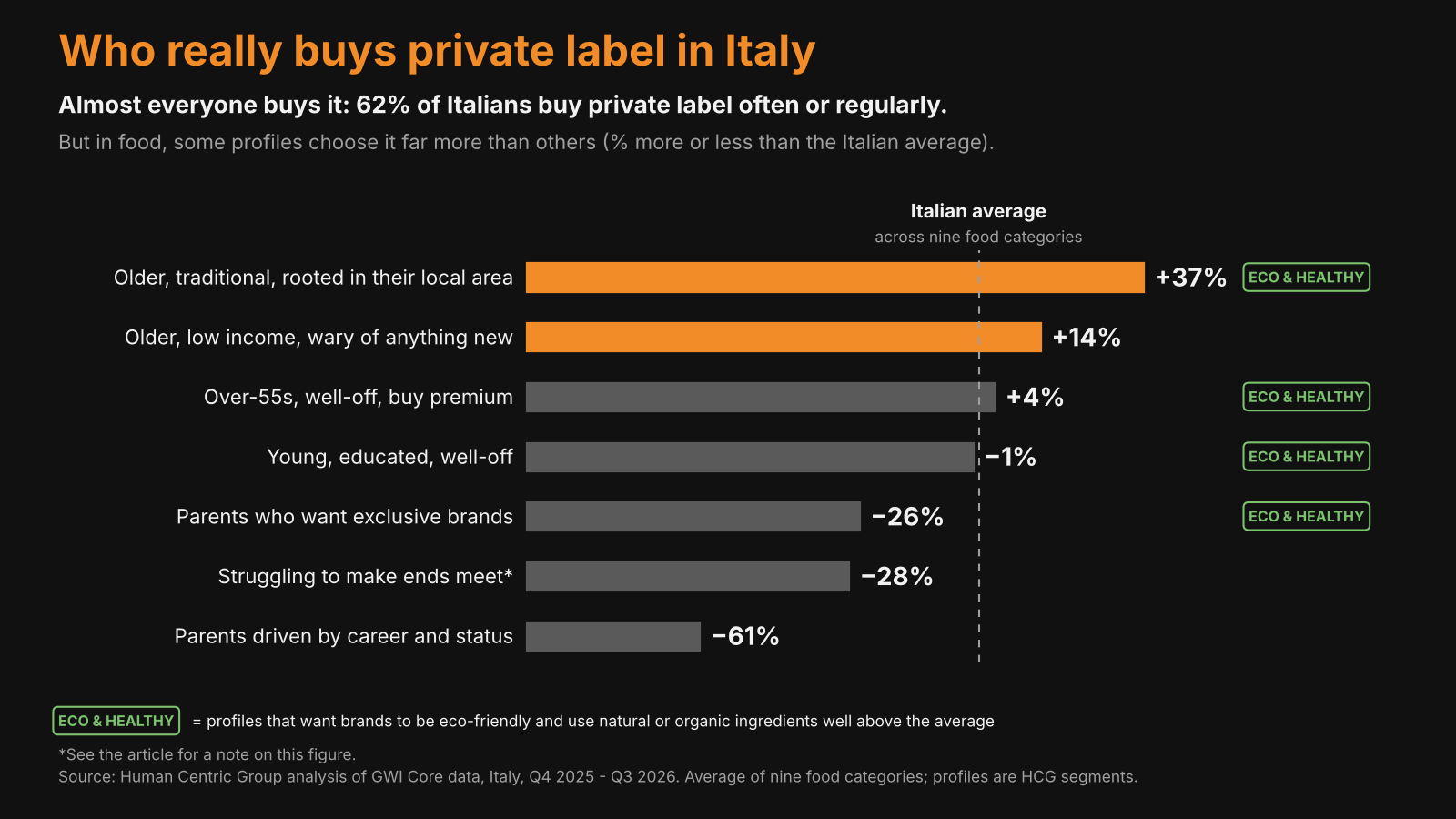
- Older, traditional Italians attached to their local area, often women, loyal to neighbourhood shops. In food they buy 37% more private label than the average Italian. They are one and a half times more likely than average to want brands to be eco-friendly and to use natural ingredients.
- Older Italians on low incomes, wary of anything new. They buy 14% more private label than average: here, price still plays its classic role.
- Shoppers who buy premium for quality and values find an answer in the retailer's range too. They are educated, well-off young adults and affluent over-55s who travel and look after their health. They buy premium versions more often than average, and store brands as much as the average Italian. The most likely explanation is the retailers' premium lines, which offer the quality and values these shoppers look for.
Those who don't choose it are looking for distinction. Parents on the highest incomes, for whom career and status are part of who they are, buy 61% less private label than average, and twice as many premium versions. The most interesting case is parents, often men aged 45 to 54, with above-average incomes and a strong environmental conscience. They want brands to stand for environmental values more than average, yet buy 26% less private label. The difference is that they want exclusive brands: they look for sustainability, but with a name on it.
The paradox: those who count every euro are not the biggest buyers. In GWI data, the people who struggle most financially buy 28% less private label than average. One possible explanation: part of their shopping happens at discounters, where the retailer's own brand may not be seen as a "supermarket brand" and so is not reported as one.
Why are organic, local and healthy no longer enough?
Shoppers who ask brands for values buy more private label, not less. In Italy and Spain, people who want brands to be eco-friendly buy 14% more private label in food than the average shopper. People who want exclusive brands buy 19% less. The pattern holds in every one of the nine food categories analysed, from snacks to coffee, though only slightly for sweets (GWI).
Of the six HCG segments most likely to want eco-friendly brands, five buy about as much private label as the average Italian, or more. The only exception, eco-minded parents on high incomes, is also the one that wants exclusive brands and buys premium versions twice as often as average. What keeps them with brands is not green: it is distinction.
HCG's 16 Italian segments tell the same story. The more a segment wants brands to be traditional and reliable, to support local suppliers or to use natural and organic ingredients, the more private label it buys. The more it wants exclusivity, status and premium versions, the less it buys, and this second link is the strongest in the data.
The reason is simple. Retailers have built ranges that answer exactly these needs: supply chain, origin, organic, local and functional lines. And they do it with the industry's credibility: 74% of Italians say it matters that a store-brand product is made by a known manufacturer (Istituto Piepoli).
Premium protects a brand mainly when it is about status. Shoppers who buy premium to stand out stay loyal to brands. Those who buy it for quality and values now find an alternative in the retailers' premium lines, and buy private label as much as everyone else. Innovation on its own makes no difference.
The one thing a store brand cannot build: a community
A retailer can copy a claim in a few months. A community around a brand takes years, and it lives outside the store. In HCG's segments it is one of the clearest dividing lines: the more a segment wants brands to run communities, make them feel valued and offer personalised products, the less private label it buys. These are largely the same shoppers who want exclusive brands.
For a brand, this means investing where the retailer has no voice: in the people who use the product together, talk about it and recognise themselves in it, from events and clubs to content on social media. A store brand can sit next to you on the shelf. It cannot sit at the same table.
Three paths, profile by profile
The choice between defending, producing for the retailer and repositioning is not made once for the whole company. It is made for each customer profile.
- Shoppers who choose on values (sustainability, local origin, health, reliability): produce for the retailer. Premium and functional store-brand lines: your know-how is worth something even without your name on the pack.
- Shoppers who choose to stand out (exclusivity, status, premium): defend. Invest in what the brand means, not in promotions: limited editions, community, genuinely premium products.
- Shoppers who want sustainability with a name on it (sustainability and exclusivity together): reposition. Turn sustainability into a distinctive sign the retailer cannot copy.
The copy test. Before investing in a claim, ask yourself: could the retailer put it on its own pack tomorrow?
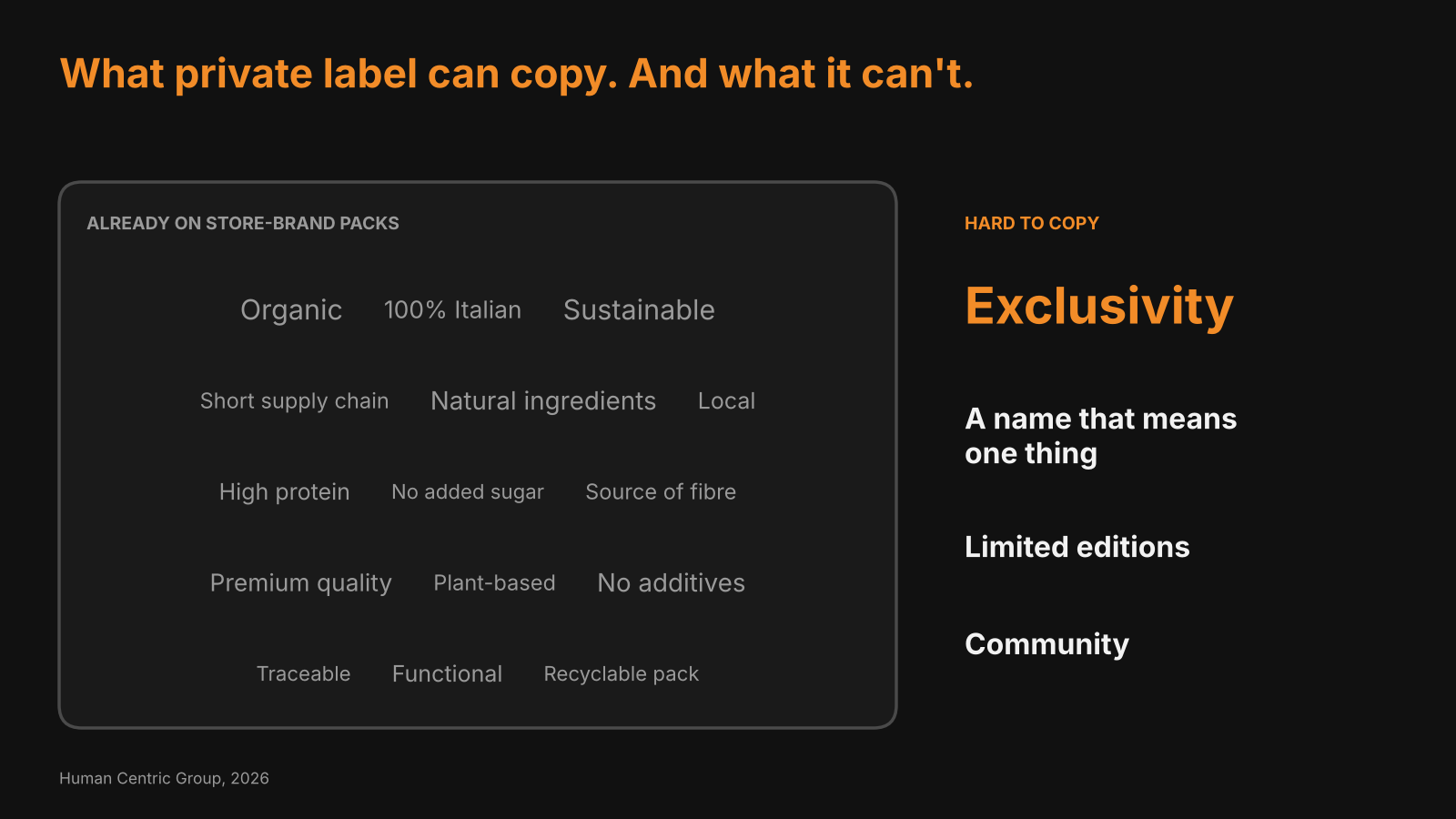
- Yes, and it often already does: "100% Italian", "short supply chain", "organic", "sustainable", "no additives", "high protein", "source of fibre", "no added sugar".
- Much harder: a community around the brand, exclusivity, specialisation in a single raw material tied to one name, presence in restaurants, limited editions, personalisation.
Mutti is a good example of successful repositioning. Its logo reads "solo pomodoro" (only tomato). The company works with around 700 farmers, pays more than 12% above the average market price for its tomatoes (Linkiesta), and is also present in restaurants. A retailer can build a supply chain too. It cannot build a name specialised in a single raw material for over 120 years.
What changes in negotiations with retailers?
In negotiations, what counts is knowing which customers your brand brings in, not just your price list.
- Show that you bring customers private label does not reach. If your brand attracts shoppers looking for distinction, you add to the retailer's offer instead of duplicating its own brand.
- Tailor the argument to the retailer. A chain in small towns and one in big cities have different customers, and so a different weight of shoppers who choose on values.
- If you produce for the retailer, choose which profiles. Lines for shoppers who choose on values do not take customers from your brand; lines aimed at those looking for distinction do.
- Your know-how is a bargaining chip. The credibility of private label also depends on the manufacturer behind it.
- Negotiate the timing of innovation. As Amalia Menna Pantaleo (Nicola Pantaleo SpA) said at Tuttofood 2026, innovation often starts with the brand and later moves to private label as a service to the retailer. Better that it reaches the shelf first under your name.
How we read the data. Human Centric Group divides the Italian population into 16 segments by life stage and motivation. We crossed these segments with GWI data (Italy, Q4 2025 to Q3 2026, internet users) on store-brand purchases in nine food categories: snacks, ice cream, biscuits, yoghurt, coffee, cereal, tea, chocolate and sweets. Percentages show how much more or less each group buys than the Italian average, across the nine categories. When asked how often they buy private label, all profiles answer similarly; the differences appear in the brands they actually use in each food category. The comparison between shoppers who want sustainable brands and those who want exclusive ones covers Italy and Spain together. The profiles described correspond to the HCG segments Caregivers, Survivors, Creatives, Dolce Vitas, Go-Getters, Liberals and Strivers.
Frequently asked questions
What is private label?
A product sold under the brand of the retailer that sells it, not of the company that makes it. It is also called a store brand or own brand.
What is the difference between private label and white label?
Private label is made for a single retailer, which sells it under its own brand. A white label product is a generic product that the same manufacturer sells to several resellers, each under its own name.
What are private label brands?
The retailers' own brands, often split into several lines: value, premium, organic, functional.
What does marca blanca mean?
It is the Spanish term for private label.
About the author

Mattia De Nardi
Mattia De Nardi is a Junior Strategy Consultant at Human Centric Group, with a dual background in Food Science and Food & Wine Business (LUISS Business School), he brings a mix of technical product knowledge and commercial thinking. Previously, at Barilla Group, he co-led the development of a new bakery product from concept to launch. He has also worked in wine and retail operations in Australia and France, and is a certified AIS Sommelier.
Other sources
- GDOWeek, Despar targets €5bn in 2027, private label towards 30% (2026)
- ItaliaOggi on Circana data, private label grows in Europe, H1 2026
- Circana for BolognaFiere, Rapporto Marca 2026 (press release)
- Tuttofood, Brand and private label panel with Istituto Piepoli survey (2026)
- Mutti, foodservice and supply chain
- Linkiesta, inside Italy's tomato preserves industry (2025)