
Black Friday 2026 falls on 27 November, and across Europe it brings something new to the purchase journey: artificial intelligence. According to BCG, which surveyed more than 10,000 consumers in ten countries, more than half of shoppers will use AI for Black Friday, far more than last year.
For anyone working in marketing, the more useful question is how AI will change Black Friday. We combined BCG's data with GWI data on six markets: Spain, Italy, Germany, France, the UK and, as a benchmark, the US. The picture is clear: AI builds the list and compares prices, but the final choice still belongs to the shopper, who rewards the brands they know and trust. And each European country gets there in its own way.
Black Friday 2026: what a CMO needs to know in five points
- AI enters the search rather than the cart. More than half of consumers will use it, but only around one in twenty would let it make the purchase.
- People mostly ask AI about price. Comparing prices and features is the task they trust it with most.
- Trust is won by reputation and guarantees. AI-generated review summaries barely move it.
- Social media is losing ground as a source of inspiration in every market, while AI is gaining it.
- Europe is not a single market. Spain, Italy, Germany, the UK and France approach Black Friday with different habits.
1. AI builds the shortlist, shoppers make the choice

The first mistake to avoid is thinking that Black Friday 2026 will be decided by algorithms. Consumers use AI to search, compare and narrow down their options, far more than to buy. According to BCG, the tasks people trust AI with most are comparing prices across stores and comparing product features. And in GWI Pulse data from November 2026, collected in eleven countries on AI in Christmas shopping, only around one European in twenty would let AI make the purchase for them.
What it means for a brand. If AI builds the shortlist, the first challenge is getting on it. An assistant compares what it finds: regular and discounted price, specifications, availability, return conditions. If that information is incomplete or inconsistent across your website, marketplaces and product pages, your product simply stays out of the comparison.
2. Europe: the same Black Friday, different habits
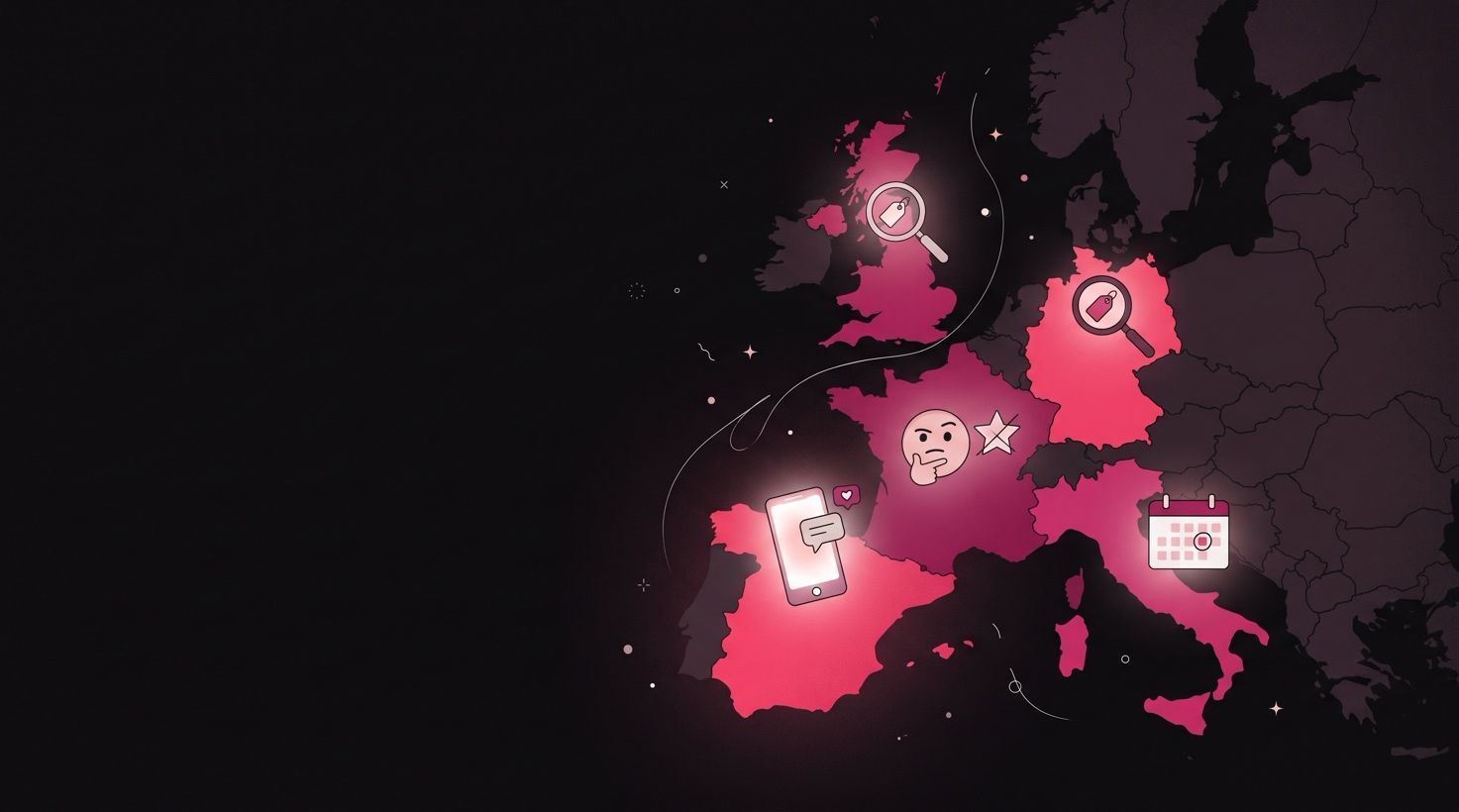
In GWI Core data from the past year, in every European country we analysed most people would rather wait for a sale than pay full price: from around seven in ten in France to more than eight in ten in Italy. But the way people get to the deal varies a lot from one country to another.
- Spain: furthest ahead on AI, and the most social. Around one Spaniard in four already uses AI as their main source of product information, the highest share among the European countries analysed. Social media also matters more in product research than in the other markets.
- Italy: waits for the moment, and is curious about AI. Italians are the most willing to wait for sales, but rather than hunting for deals all year, they bet on the right moment. Almost half plan to use AI for their Christmas gifts, more than in the other European countries, although few are sure yet.
- Germany and the UK: year-round deal hunters. More than half say they spend time looking for the best deals, but only around one in three plan to use AI for their Christmas shopping.
- France: the most detached. It is the country least attached to deal hunting and the one that trusts online reviews the least.
What it means for a brand. A European Black Friday plan copied from one country to the next wastes budget. In Spain, what matters is being readable for AI and present on social media; in Italy, being there at the right moment with a credible offer; in Germany and the UK, holding up to price comparison for weeks; in France, winning over shoppers who start out sceptical.
3. Trust is built before Black Friday

BCG measured what increases or reduces trust during Black Friday. At the top are the store's reputation and a money-back guarantee, followed by verified-purchase reviews and a clear comparison between the regular and discounted price. At the bottom are AI-generated review summaries, which barely move trust, and influencer recommendations.
Trust in the discount itself is fragile too: only just over half of consumers believe Black Friday prices are genuinely lower than usual, and one in five actively distrusts the deals.
GWI data adds a paradox: reviews are used more than they are trusted. In almost every European country we analysed, only around one person in four says they trust online reviews, and even fewer in France, yet reviews remain one of the most used sources of product information.
What it means for a brand. Trust is built before Black Friday rather than during discount week: with visible guarantees, credible reference prices and a consistent experience over time. That is what makes the difference once AI has narrowed the choice down to three options.
4. Inspiration is shifting and the calendar is getting longer
Where the idea of buying starts, something is really changing. According to BCG, social media is losing weight as a source of Black Friday inspiration in every market studied, while AI is gaining it: in Italy, for example, the share of people who take inspiration from AI has doubled in a year. Traffic is moving the same way: according to Salesforce, visits to e-commerce sites coming from AI tools have more than doubled, although the figure covers English-speaking countries and comes from a technology vendor.
Meanwhile, Black Friday keeps getting longer. In Italy one consumer in three starts looking for deals in early November (BCG), and after Black Friday 2025 the most cited lesson was "start monitoring prices earlier" (GWI Pulse). That is exactly the job people hand over to AI.
What it means for a brand. 27 November is the finish line rather than the starting point. In the weeks before, AI and consumers build the list: if you're not on it then, you're unlikely to be chosen later.
A CMO checklist before 27 November
- Product data: are price, specifications, availability and returns clear and identical across every channel?
- Reference price: can you prove the discount against a credible regular price?
- Guarantees: are returns and refunds visible before the cart, as well as in the terms and conditions?
- Plan by country: are you running the same plan across Europe or one for each market?
- People rather than averages: do you know which segments of your customers look for price and which for quality or image? As we showed when analysing Gen Z characteristics, opposite motivations live within the same age group.
Black Friday 2026 FAQ
When is Black Friday 2026?
Friday 27 November. In Italy, according to the Politecnico di Milano and Netcomm Observatory, Black Week runs from 23 to 30 November.
How much will be spent online on Black Friday 2026?
In Italy, the eCommerce B2c Observatory of Politecnico di Milano and Netcomm estimates about €4.3 billion in Black Friday week, 6% more than in 2025.
Will consumers use AI for Black Friday?
Yes, mainly to search and compare rather than to buy. According to BCG, more than half of consumers will use AI for Black Friday, but almost nobody lets it complete an order without checking it.
Can you trust Black Friday discounts?
Many doubt it: according to BCG, only just over half of consumers believe Black Friday prices are genuinely lower than usual. That's why the retailer's reputation, guarantees and a clear reference price matter.
Sources and method
- BCG, Annual Black Friday Survey, press release of 4 November 2026: 10,220 consumers in 10 countries. The Italy data (1,013 respondents) are as reported by Affaritaliani on 11 November 2026.
- eCommerce B2c Observatory of Politecnico di Milano and Netcomm, forecast for Black Friday 2026 in Italy.
- GWI Core, internet users, data collected from Q4 2025 to Q3 2026 in Spain, Italy, Germany, France, the UK and the US. Analysis by Human Centric Group.
- GWI Pulse, November 2026 (AI in Christmas shopping, 11 countries, about 1,000 internet users per country; Spain is not included) and December 2025 (Black Friday 2025 recap).
- Salesforce, survey of more than 2,500 consumers in the US, UK, Canada and Australia; Salesforce is a retail technology vendor.
About the author

Mattia De Nardi
Mattia De Nardi is a Junior Strategy Consultant at Human Centric Group, with a dual background in Food Science and Food & Wine Business (LUISS Business School), he brings a mix of technical product knowledge and commercial thinking. Previously, at Barilla Group, he co-led the development of a new bakery product from concept to launch. He has also worked in wine and retail operations in Australia and France, and is a certified AIS Sommelier.