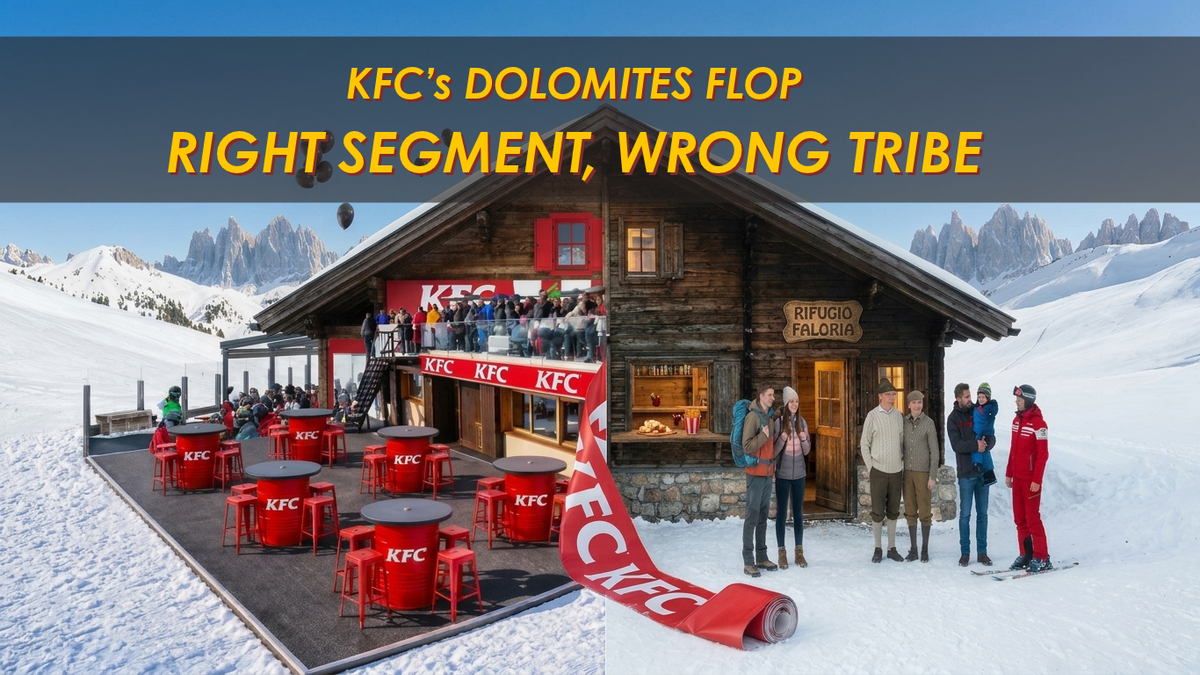
On November 5, KFC announced it was going up, way up! Two KFC restaurants directly on the ski slopes of the Dolomites, opening December 5 with Super G, the group behind some of the loudest après-ski in the Alps. One in Madonna di Campiglio (1,700 metres), the other in Cortina, inside the Faloria refuge (at 2,123).
Five days later, the Cortina restaurant promise was gone.
In between there was a petition that passed a thousand signatures in two days, two ministers saying fast food and mountains don't mix, and the largest shareholder of the local lift company threatening to take his own board to court. By November 10, the plan had shrunk to six KFC products sold at the refuge bar: no restaurant with a logo on the building.
KFC in the Dolomites: everyone blamed the chicken
The easy reading writes itself: fried chicken doesn't belong on a mountain! It is the reign of polenta, canederli, roe deer stew… and I stop here because my mouth is watering already.
Nevertheless, the chicken is still there. From December 5, if you ski down to the Faloria bar, you can order KFC next to the local specialities. What disappeared instead is the restaurant, the branded façade, the render showing the refuge wrapped in KFC branding (Faloria's board said it had never approved that image in the first place).
So it wasn't really the product, since the menu survived the backlash. What didn't survive was KFC walking into the refuge as if it owned the place. To see why, you need two words that brands tend to use as synonyms, and really shouldn't: segment and tribe.
Behind "Gen Z", a Poser
In the press release, KFC was clear about its audience: Gen Z has always been one of its most loyal publics.
"Gen Z" is an age. It tells you when someone was born, not what they want. At Human Centric Group we start from somewhere else: a segment is who you are. Your life stage, your values, what you spend on and why. Italy, in our model, splits into sixteen of them.
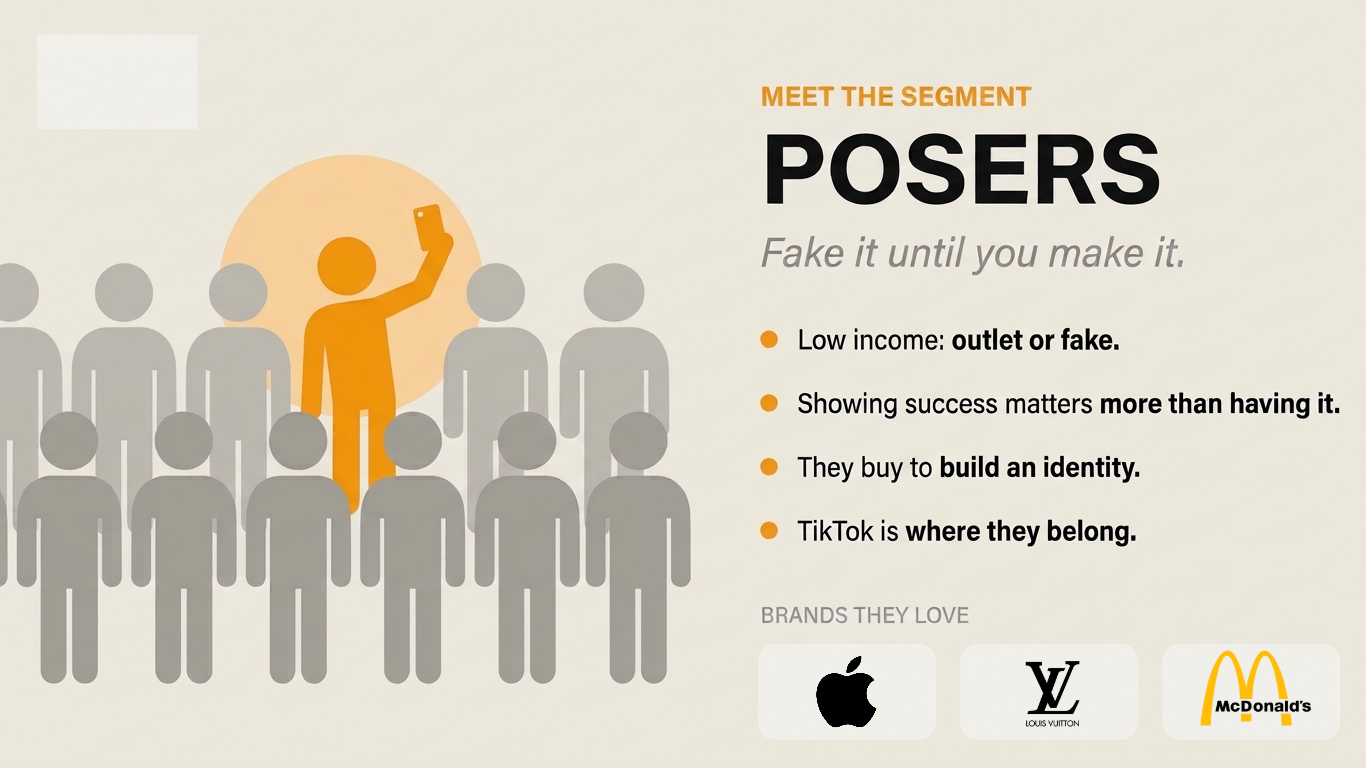
The one hiding behind KFC's "loyal Gen Z" has a name. We call them Posers.
Posers are young, 42% of them between 18 and 24, and they don't earn much. That doesn't stop them: they're not price-conscious, they buy at full price and they'll give up something else to get what they want right now. What drives them is visibility. Their motto, if they had to pick one, would be fake it until you make it: showing success matters more than having it. The screen is where they belong.
For a brand like KFC, in a city, that's close to a perfect match. A bucket is cheap enough, loud enough, shareable enough. What we get from that is clear: KFC didn't pick the wrong segment. But we must distinguish segments from tribes.
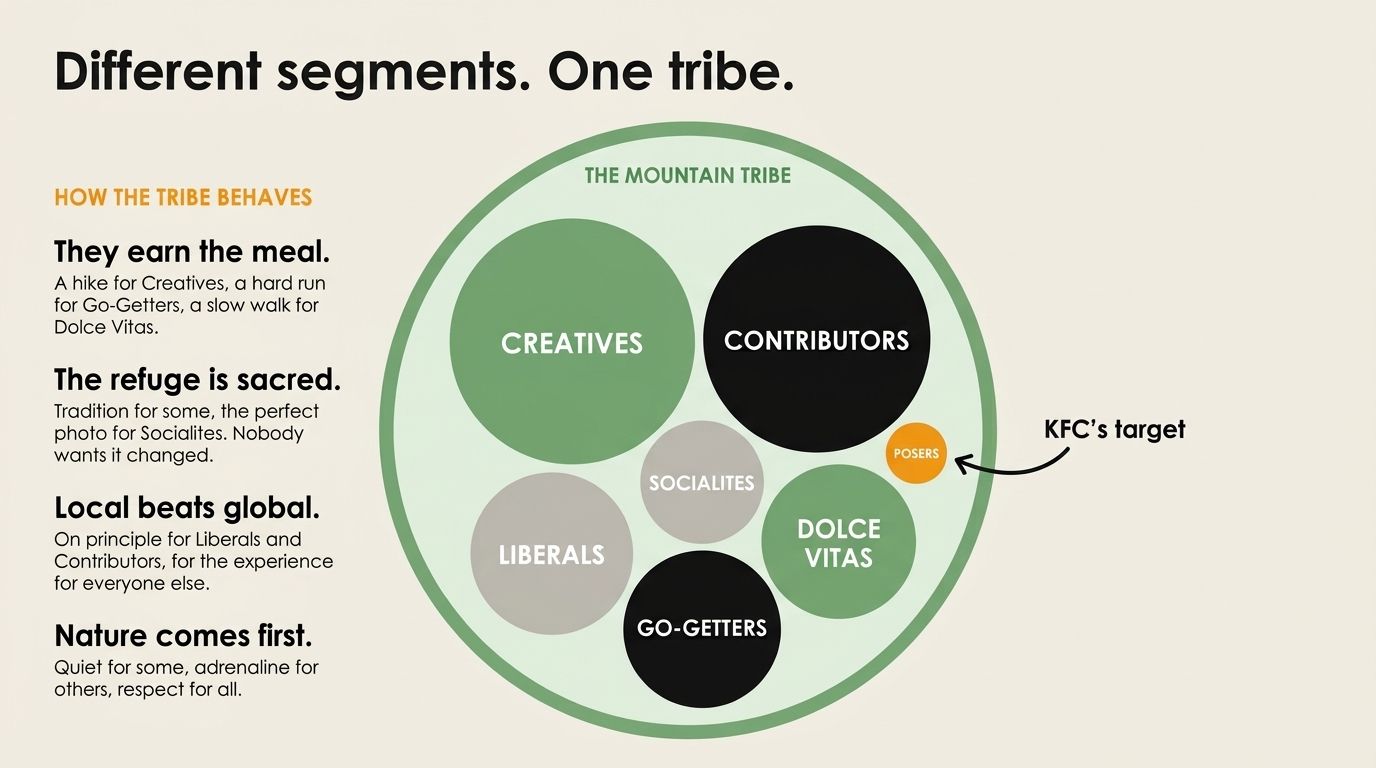
A mountain is not a location. It's a tribe.
If a segment is who you are, a tribe is where you recognise yourself. It's a community built around a place or a passion, with its own rituals, its own codes and usually a totem or two. And here's the part brands miss: segments, when they are part of a tribe, behave by the tribe's rules.
Look at who, in our data, is drawn to the mountain. Creatives, young and curious, with a strong pull towards hiking and even extreme sports. Contributors, parents who live outdoors and put the environment above almost everything. Liberals, parents who care about local issues and the planet. Dolce Vitas, the most travelled of the over-55s. Go-Getters, chasing adrenaline and a bit of status in Cortina. Socialites, mostly young women posting carousels on TikTok with the perfect hiking set or dancing at the après-ski. Different ages, incomes, life stages. On paper they have nothing in common.
However, on the mountain they share almost everything: the effort before the meal, the polenta, the quiet, the pictures (even if taken for different reasons). And there's one thing they'd defend together: the refuge.
You could hear the tribe speaking in the days after the announcement. "Cortina is not just any place. Faloria is not just any mountain," wrote the lift company's largest shareholder. Campiglio's mayor said it didn't reflect the town's identity, culture or history. Not one of them was talking about calories. They were talking about who belongs.
Same kid, two altitudes
Let's call her Giulia. She's 21, works part-time, and on a Saturday afternoon she's at the KFC in a shopping centre outside Milan: bucket on the table, phone up, a quick video before the first bite. In that place, the brand is part of the picture she wants to give.
Now put the same Giulia at 2,123 metres. Maybe it's a different kind of Saturday, maybe she saved for it, maybe the jacket is borrowed. Fake it until you make it, remember. She walks into the Faloria refuge, and what does she order for the photo? Certainly not the bucket. The cheese board, the canederli, the pint of beer against the Dolomites. Up there, it's the tribe that decides what counts as status.
Same girl, same segment, but opposite behaviour (which is the whole point). A segment tells you how someone behaves by nature, whereas a tribe tells you how they behave in that place. When the two disagree, the tribe wins.
And there's a second problem. In Cortina, Giulia is a guest. Posers are unlikely regulars up there: low incomes and Cortina prices don't go well together. KFC talked to a segment that, inside that tribe, barely has a voice. The people who do have one (the lift company, the locals, the long-time regulars) were never asked.
Tribe first, segment second
Was there a way to make it work? I think so, and it doesn't need a bigger budget, just a different order.
Keep the logo off the totem: the refuge isn't a billboard, and the moment it looks like one, the tribe stops seeing a new option on the menu and starts seeing an invasion. Make one product with someone from the valley, a local cheese, a local beer, anything that says we asked before coming in. Live inside the après-ski ritual, where the music and the crowd already are.
None of this would have made KFC a mountain brand, but a welcome guest, which is all a brand needs to be in someone else's house.
That's the lesson, and it goes well beyond fried chicken or the Dolomites. Segments tell you who will buy, whereas tribes tell you where you're allowed to sell. Most brands spend months on the first question and minutes on the second, and that is exactly the gap we work on at HCG.
So before your next launch, next to who is our target?, write a second question.
Whose house are we walking into?