Generative Engine Optimization (GEO) starts with a simple question: when someone asks AI who can solve their problem, is your brand part of the answer?
Imagine a marketing director asking ChatGPT, "Which consulting firms can help us understand why similar customers behave differently?" The answer names several companies. Yours is missing.
Now imagine asking, "What does [your company] do?" Suddenly, the same AI can describe your services.
Being recognized when someone names you is not the same as being recommended when they need you.
This is why GEO deserves attention from CMOs, not just SEO specialists.
Generative Engine Optimization: a new brand visibility challenge
Search Engine Optimization (SEO) helps people discover your website through search results. Generative Engine Optimization focuses on how tools such as ChatGPT, Google Gemini and Claude find, describe, cite and sometimes recommend brands in their answers.
These tools are AI assistants: conversational services that respond to questions in everyday language. Rather than showing only a list of links, they can summarize options, compare suppliers and suggest what to consider next.
For a brand, three questions matter:
- Discovery: Are you suggested when customers describe a problem without naming you?
- Representation: Does the AI accurately explain what your company offers and who it helps?
- Evidence: What sources support its description, and what information is missing?
An AI assistant can influence the initial shortlist. That makes GEO as much a question of positioning and reputation as of technical visibility.
Why the conversation is changing now
On 10 November 2026, OpenAI introduced Businesses in ChatGPT. Through its Business Hub, eligible companies can claim and update business information and review aggregated insights such as mentions, website clicks and topics through which people discover them.
That is useful visibility data, but it is limited to ChatGPT. Conversations remain private, and a mention or click is not evidence of a purchase. Eligibility and verification can vary. The separate Business Agents feature initially serves eligible businesses in the United States; sponsored placements are labelled and distinct from ChatGPT's independent answers.
On 16 November, Bloomreach announced its acquisition of AthenaHQ, a company focused on visibility within AI answers.
The commercial interest is growing. But what should a marketing team actually measure?
We tested our own brand. The results were revealing.
At Human Centric Group, we decided to test our visibility rather than simply write about it.
On 18 November 2026, we asked 28 questions to each of three AI assistants: ChatGPT, Gemini and Claude. Some questions described business problems, others asked for consultancy recommendations, and a few mentioned HCG by name.
Here is what we found:
- 84 answers recorded in total.
- 43 answers named at least one company as a possible provider.
- 5 of those 43 answers included HCG among the named companies, always in response to questions that already mentioned HCG.
- 38 answers named possible providers in response to questions that did not mention HCG.
- 0 of those 38 answers included HCG.
- 2 answers mentioned humancg.com in their text. Neither recorded the website as a cited source.
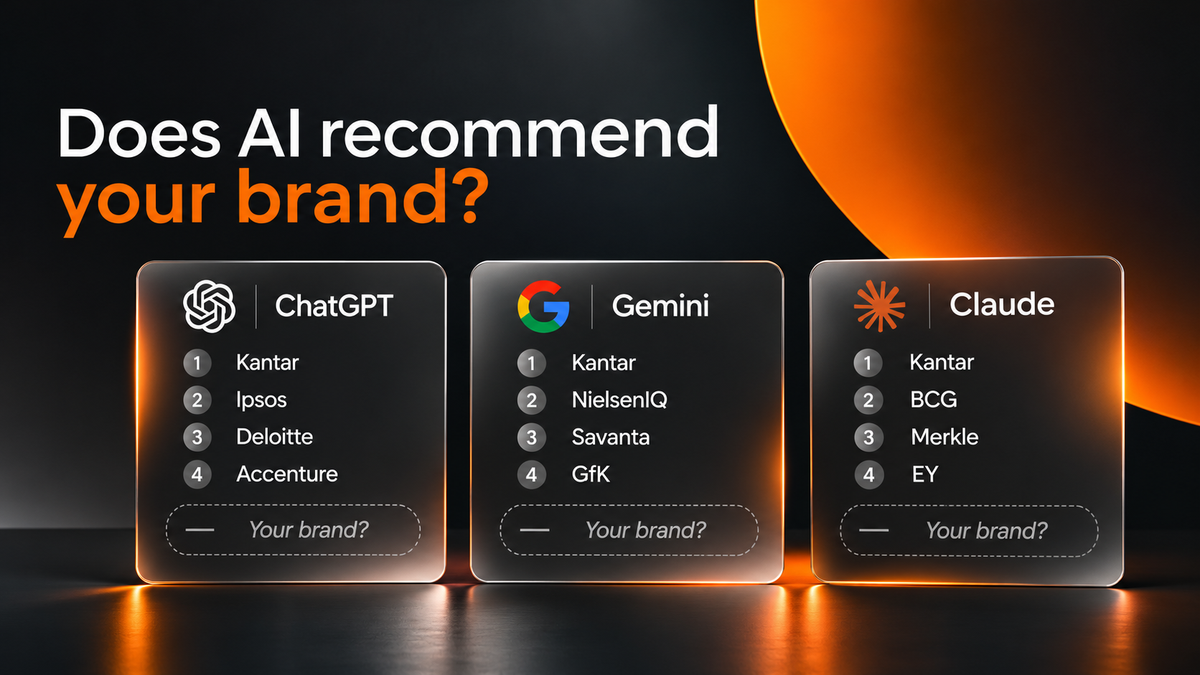
Consider the question, "Best agencies for customer segmentation." The assistants mentioned companies such as Kantar and Ipsos, but not HCG. When we asked directly about HCG, they recognized the company.
That distinction is our central finding: we were identifiable by name, but absent from the unprompted supplier recommendations in this test.
This was one exploratory test involving one company and a fixed set of questions. It does not represent every possible answer or prove that HCG lost customers. AI responses can change with wording, language, location, model and time. Only 16 of the 84 recorded answers involved a web search. We also excluded answers that gave advice without naming any potential provider from the supplier inclusion figures. The original questions and response texts are retained in HCG's research records.
Nevertheless, the test revealed a useful question for our own positioning. Are we explaining our expertise in the language customers actually use when looking for help?
Why more content is not necessarily the answer
A company might describe itself as an expert in customer centricity, segmentation and brand strategy. A buyer may simply ask, "Our customers look the same on paper but buy for completely different reasons. Who can help us understand why?"
If the website does not make the connection clear, the brand may be overlooked.
Research by Chen and Koudas on citations in AI generated answers suggests that how systems retrieve and interpret information matters alongside the content itself. This is an academic preprint, not a universal formula for gaining recommendations.
The practical lesson is that GEO should start with customer questions, clear positioning and credible proof, not a rush to produce more pages.
A practical AI brand visibility audit in four steps
You can conduct an initial audit without purchasing specialist software.
1. Start with the questions customers really ask
Collect 20 to 40 questions from sales conversations, customer interviews, search data and actual briefs. Group them by intent:
- Problem questions: "Why do similar customers behave so differently?"
- Provider questions: "Which firms can help us segment customers by motivations?"
- Brand questions: "What does our company do, and who is it for?"
Keep the groups separate. A mention that follows a question containing your brand name is not an independent recommendation.
2. Compare different AI assistants and markets
Test the same questions with the conversational AI tools your customers might use, such as ChatGPT by OpenAI, Gemini by Google and Claude by Anthropic.
Record the date, country, language, tool and whether it searched the web. Repeat the exercise at different times. These assistants do not always give the same answer, even to an identical question.
3. Look beyond simple brand mentions
When an answer suggests suppliers, ask:
- Were we recommended without being named first?
- Which competitors appeared instead?
- Was our positioning described accurately?
- Which sources supported the answer?
A citation is not a recommendation. A recommendation is not a website visit. And a visit is not a sale.
4. Close the gaps, then test again
Make the website easier to understand, for both people and machines. Explain the problems you solve in plain language. Support claims with relevant cases, research and identifiable expertise. Check that service information is accurate, accessible and consistent across credible sources.
Then repeat the same questions. Compare the results over time without assuming that a particular edit will automatically change an AI answer.
What should CMOs track?
Focus on a small set of meaningful indicators: unprompted recommendations for relevant buyer questions, the competitors suggested instead, accuracy of brand descriptions and quality of cited sources.
Where possible, compare these findings with referral traffic, qualified inquiries and actual commercial outcomes. A rising mention count is interesting. Being considered by the right customers is the real objective.
Being known is not enough
GEO is often discussed as a new way to optimize content. We think it raises a more fundamental question about brand strategy.
When a customer describes a need that your company can solve, does AI understand why you belong in the conversation?
Our own experiment exposed a gap between name recognition and spontaneous recommendation. It gave us something concrete to investigate, which is far more useful than another vanity metric.
Before investing in more content or another visibility platform, establish where your brand appears, where it disappears and what evidence might explain the difference.
FAQ
Is Generative Engine Optimization the same as SEO?
No. SEO focuses on visibility in search results. GEO examines how brands appear, are cited and are represented in AI generated answers. Strong content and accessible websites can support both, but neither guarantees recommendations.
Can a brand pay to be recommended by ChatGPT?
Sponsored business experiences are available in certain contexts, but they are labelled and separate from independent ChatGPT answers. Paying for a placement does not guarantee an organic recommendation.
Can AI brand visibility be measured reliably?
It can be monitored through repeated tests with consistent questions and a clear methodology. No single test captures every customer interaction. Always distinguish recommendations made without a brand prompt from answers that merely recognize a name.
Related HCG perspectives: Black Friday 2026 and AI · When Technology Becomes a Relationship · Why KFC Lasted Five Days in the Dolomites
Methodology: HCG tested 28 fixed questions across ChatGPT, Gemini and Claude on 18 November 2026. The figures describe this exploratory round only, not market shares, typical buyer behavior or the commercial impact of AI recommendations.
About the author

Luca Bertocci
Luca Bertocci is a co-founder and co-owner of Human Centric Group, where he partners with boards, founders, and C-level executives to transform brands into strategic business assets. He leads the agency’s analytical department, applying a data-driven approach to unlock sustainable, long-term value for global clients such as Carlsberg, PepsiCo, Danone, Mitsubishi Electric, and Carrefour, across more than 30 countries.
Before Human Centric Group, Luca was an equity partner at Garrison Group and held key roles at Pirelli Tyres and Desk Promos (special agency of the Italian Chamber of Commerce) during Expo Shanghai 2010.
Beyond consulting, Luca is a lecturer at Krakow School of Business (International MBA), and AGH Business School (EMBA and Tech MBA). He also serves as a mentor for Bocconi University and for several startups in Poland, combining entrepreneurial spirit with academic rigor.