Something interesting is happening in our conversations with clients.
They are no longer asking us simply to identify their most valuable customer segments.
They want to interact with them. Explore the data themselves. See how their preferences evolve. Ask them questions about new products, competitors, and advertising campaigns.
And, most importantly, they want to know whether their marketing strategy is actually working.
The traditional segmentation report, however sophisticated, is no longer enough.
The next generation of AI market research is turning customer segmentation into something businesses can use every single day.
The Problem Is Not Segmentation. It Is What Happens Afterwards.
A well-executed customer segmentation project can transform a business. It reveals why seemingly similar consumers behave differently, identifies the most attractive growth opportunities and provides the foundation for brand positioning, product innovation and commercial strategy.
Yet companies often invest months in understanding their audiences, only to end up with a PowerPoint presentation, a set of spreadsheets and a database that few people outside the research team know how to navigate.
Three months later, the marketing director wants to understand whether consumer priorities have changed.
Six months later, the innovation team wants to know how a specific segment would react to a new product.
Meanwhile, the commercial director wants to understand whether the company's newly acquired customers actually belong to its strategic targets.
Every new question potentially requires another analysis, another briefing or another research project.
And this is where AI can fundamentally change the experience.
AI Market Research: The Living Segmentation Model
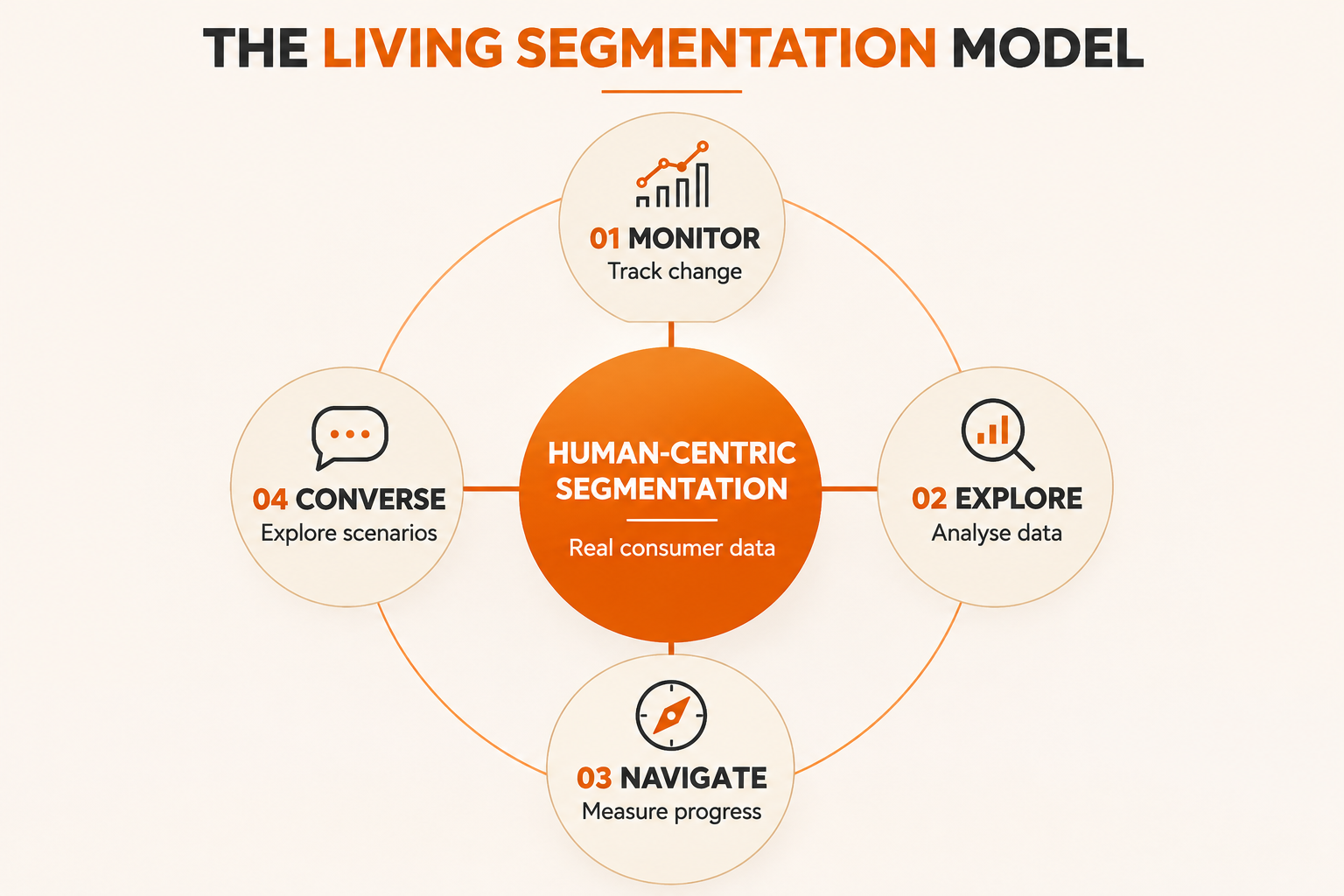
At Human Centric Group, we believe the next evolution of customer segmentation should revolve around four capabilities: Monitor, Explore, Navigate and Converse.
We call this the Living Segmentation Model: an approach that combines human-centric consumer research, regularly updated data, interactive analytics, strategic performance tracking and conversational AI.
Imagine an insurance company that has identified young professionals as one of its most attractive growth opportunities.
What could a living segmentation system enable its management team to do?
01. Monitor: Understand How Your Customers Are Changing
Consumers respond to inflation, technological innovation, cultural shifts, competitive activity and changes in their personal circumstances.
Their fundamental values might remain relatively stable, while their purchasing behaviour, priorities and willingness to spend evolve significantly.
Dynamic segmentation allows businesses to track these changes without necessarily rebuilding their entire segmentation framework every year.
Our insurance company could monitor how young professionals' financial confidence, perception of risk, interest in different insurance products and willingness to pay evolve over time.
Are they becoming more concerned about financial security? Are they increasingly interested in flexible coverage? Has their trust in traditional insurance providers changed?
The frequency of these updates depends on the underlying data sources. Some indicators can be refreshed monthly, others quarterly or even daily.
What matters is that management can distinguish meaningful changes from temporary fluctuations and statistical noise.
02. Explore: Put Consumer Insights in the Hands of Decision-Makers
Why should a brand manager need to commission a new analysis every time they want to cross-tabulate two or three variables?
Imagine being able to explore your customer segments independently through an intuitive interface.
Our insurance company could investigate the relationship between income, insurance ownership, digital behaviour, trust in insurance agents and openness to purchasing policies online.
Its marketing team could simply ask:
“Among young professionals who are concerned about financial security but do not currently have life insurance, which communication channels and purchase barriers are most relevant?”
An AI-enabled consumer insights platform could translate that question into an appropriate analysis, visualise the results and explain the findings.
The underlying data, sample sizes, weighting and methodological limitations should remain accessible.
The objective is to democratise access to consumer intelligence without compromising the rigour behind it.
03. Navigate: Turn Your Dashboard Into a Strategic Compass
This is where things become particularly interesting for us as management consultants.
Most companies already have plenty of dashboards.
What they often lack is a clear connection between the strategy they have chosen and the KPIs they monitor.
Our insurance company has decided to grow among young professionals. Its strategic compass should therefore help management understand whether it is succeeding with that specific audience.
Is brand consideration increasing? Are more young professionals requesting quotations? Is their conversion rate improving? Is the company acquiring the right customers at a sustainable cost?
Imagine that brand consideration increases significantly, but policy subscriptions remain flat.
The system could flag the discrepancy and suggest investigating pricing, product complexity, distribution or conversion barriers.
These are hypotheses to validate, not automatically established causes.
The real opportunity is to connect consumer understanding, strategic objectives, marketing activities and commercial performance within the same decision-making environment.
A compass should tell you whether you are moving in the right direction, how far you have progressed and where you may need to adjust your course.
04. Converse: What If You Could Talk to Your Target Audience?
Generative AI introduces another fascinating possibility: interacting with simulated representations of your customer segments.
Imagine our insurance company's innovation team discussing a new product with AI personas representing its priority audiences.
“What would make you choose our insurance policy over a competitor's?”
“What do you find confusing about this product?”
“How would you react to this advertising campaign?”
“What would make this subscription feel worth paying for?”
These conversations could help teams explore potential objections, refine value propositions, generate campaign ideas and identify hypotheses worth testing with real consumers.
Instead of reading a persona description, managers could interact with a representation of that audience.
However, the distinction between a simulated response and an actual consumer response must always remain explicit.
A synthetic persona is a research and innovation tool. It is not a human respondent.
Can Synthetic Personas Really Replace Human Consumers?
Recent research illustrates both the potential and the limitations of synthetic audiences.
In May 2026, Boston Consulting Group reported that a refined synthetic panel predicted real consumers' choices with 92% accuracy in a specific beverage conjoint experiment.
Promising results, but not a universal accuracy benchmark. BCG itself emphasised that synthetic panels cannot replace traditional market research, particularly when assessing radically innovative products.
In September 2026, Pew Research Center published a methodological experiment comparing AI-generated respondents with real human survey participants.
Across nearly 300 questions, the synthetic estimates differed from the human responses by an average of approximately 12 percentage points.
These studies examine different applications and use different measures of accuracy. Their findings are not directly comparable, but together they highlight why validation matters.
A trustworthy AI market research system should clearly distinguish three types of intelligence:
Observed intelligence: what real consumers have said or done.
Modelled intelligence: patterns, estimates and predictions derived from available evidence.
Simulated intelligence: hypothetical reactions generated by AI.
A manager asking how consumer preferences changed last month should receive an answer based on genuinely updated evidence, not an AI-generated approximation of what might have happened.
The real breakthrough in AI market research is not replacing consumers with artificial intelligence.
It is giving businesses an intelligent interface to understand real consumers better.
As we discussed in Garbage In, Garbage Out, the quality of AI-generated outputs ultimately depends on the quality of their inputs.
A synthetic consumer built on assumptions is still an assumption, however convincingly it speaks.
The Market Is Already Moving in This Direction
On November 19, 2026, Morning Consult published A Field Guide to AI-Native Market Research, showcasing AI research agents and conversational interfaces connected to real market data.
Its examples cover customer targeting, brand reputation, consumer sentiment and the impact of economic developments on brands.
This illustrates a broader opportunity: integrating consumer intelligence directly into the everyday working environment of business decision-makers.
For us at Human Centric Group, the challenge goes one step further.
Understanding consumers is only the beginning. The real value comes from translating that understanding into the right strategic decisions, executing them and continuously measuring their impact.
What Should You Expect From Your Next Customer Segmentation Project?
If you are considering a new segmentation project, we believe there are six questions worth asking your research or consulting partner:
Can we access and explore the underlying consumer data ourselves?
How frequently will our customer insights be updated?
Can we integrate our own CRM, sales and brand tracking data?
Can we monitor the KPIs associated with our strategic targets?
Can we explore new questions and scenarios through conversational AI?
How will AI-generated insights be validated against real consumers?
The answers will help determine whether you are purchasing a research project with a defined end date or building a long-term strategic capability for your business.
The difference can be substantial.
Your customers will continue to change. Your competitors will continue to innovate. Your markets will continue to evolve.
Why should your segmentation stand still?
Frequently asked questions
What is living segmentation?
Living segmentation combines human-centric research, refreshed consumer data, interactive analytics, strategic KPI tracking and conversational AI to make segmentation useful in everyday decisions.
How often should consumer insights be updated?
The appropriate frequency depends on the underlying data. Some indicators can be refreshed monthly, quarterly or daily, provided the measurements remain comparable and statistically meaningful.
Can synthetic personas replace real consumers in market research?
Synthetic personas can help explore scenarios, refine concepts and generate hypotheses. Their responses are simulations, not observations of real consumers, and should be validated against real evidence.
How can AI market research support marketing strategy?
It can help managers explore audience data, monitor changing preferences and connect strategic targets to marketing and commercial KPIs, while distinguishing observed findings from predictions and simulations.
About the author

Luca Bertocci
Luca Bertocci is a co-founder and co-owner of Human Centric Group, where he partners with boards, founders, and C-level executives to transform brands into strategic business assets. He leads the agency’s analytical department, applying a data-driven approach to unlock sustainable, long-term value for global clients such as Carlsberg, PepsiCo, Danone, Mitsubishi Electric, and Carrefour, across more than 30 countries.
Before Human Centric Group, Luca was an equity partner at Garrison Group and held key roles at Pirelli Tyres and Desk Promos (special agency of the Italian Chamber of Commerce) during Expo Shanghai 2010.
Beyond consulting, Luca is a lecturer at Krakow School of Business (International MBA), and AGH Business School (EMBA and Tech MBA). He also serves as a mentor for Bocconi University and for several startups in Poland, combining entrepreneurial spirit with academic rigor.