Pringles Original used to come in 200-gram packs. Then 190. Then 175. According to Money.it, the price per kilo in Italy rose by 22% in some cases, so every gram of crisps cost almost a quarter more. That is shrinkflation: the amount in the pack goes down while the price stays the same, or goes up.
It happens with crisps, biscuits, detergents and toilet paper. And it happens more often than you might think.
Shrinkflation has a quieter cousin, skimpflation: weight and price stay the same, but the recipe changes. Food Affairs gives the example of a packaged burger that drops from 75% to 60% meat, with cheaper ingredients making up the rest.
How common is shrinkflation? The numbers
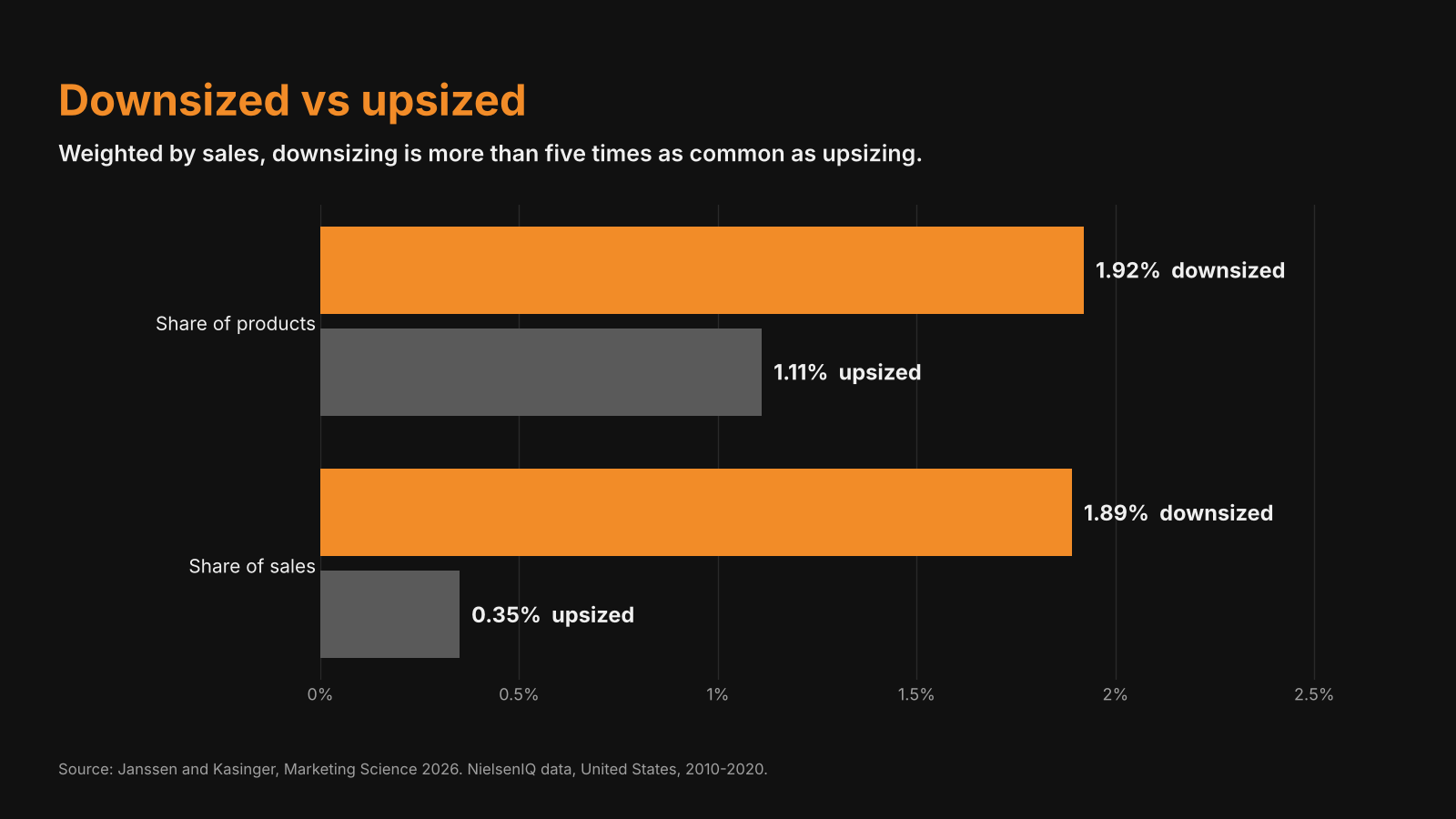
The largest study so far was published in 2026 in Marketing Science. Aljoscha Janssen and Johannes Kasinger followed ten years of NielsenIQ sales data, from 2010 to 2020, across tens of thousands of US supermarkets. About two products in every hundred were downsized. That sounds small, but weighted by sales, downsizing was more than five times as common as upsizing. And in the twelve months that followed, the price per unit of those products rose by about 12% on average. Cereals, detergents, snacks and hygiene products were hit most often.
This is not just an American story. In the UK, the Office for National Statistics recorded 2,529 price quotes for items that had shrunk between 2012 and 2017, most of them food. In Italy, Istat data quoted by the consumer group UNC counted 7,306 cases over the same period. The consumer association Codacons, as reported by Dequo, estimates that shrinkflation hides price rises of 10% to 18%, and up to 40%.
Well-known shrinkflation examples
The most famous case is Toblerone. In 2016 Mondelez widened the gaps between the peaks of the bars sold in the UK: the 400-gram bar went down to 360 grams and the 170-gram bar to 150, in the same packaging. The company pointed to the cost of ingredients, but many customers took it badly (Yorkshire Post).
Andrex, the British toilet paper brand, cut its rolls from 280 to 221 sheets. This time the brand said it had improved the quality to make up for it (Consumerist). Of the cases above, it is the only one where the cut came with a better product.
If the practice is this common, it is because it often works. The reason lies in how we look at a shelf.
Why do shoppers keep buying?
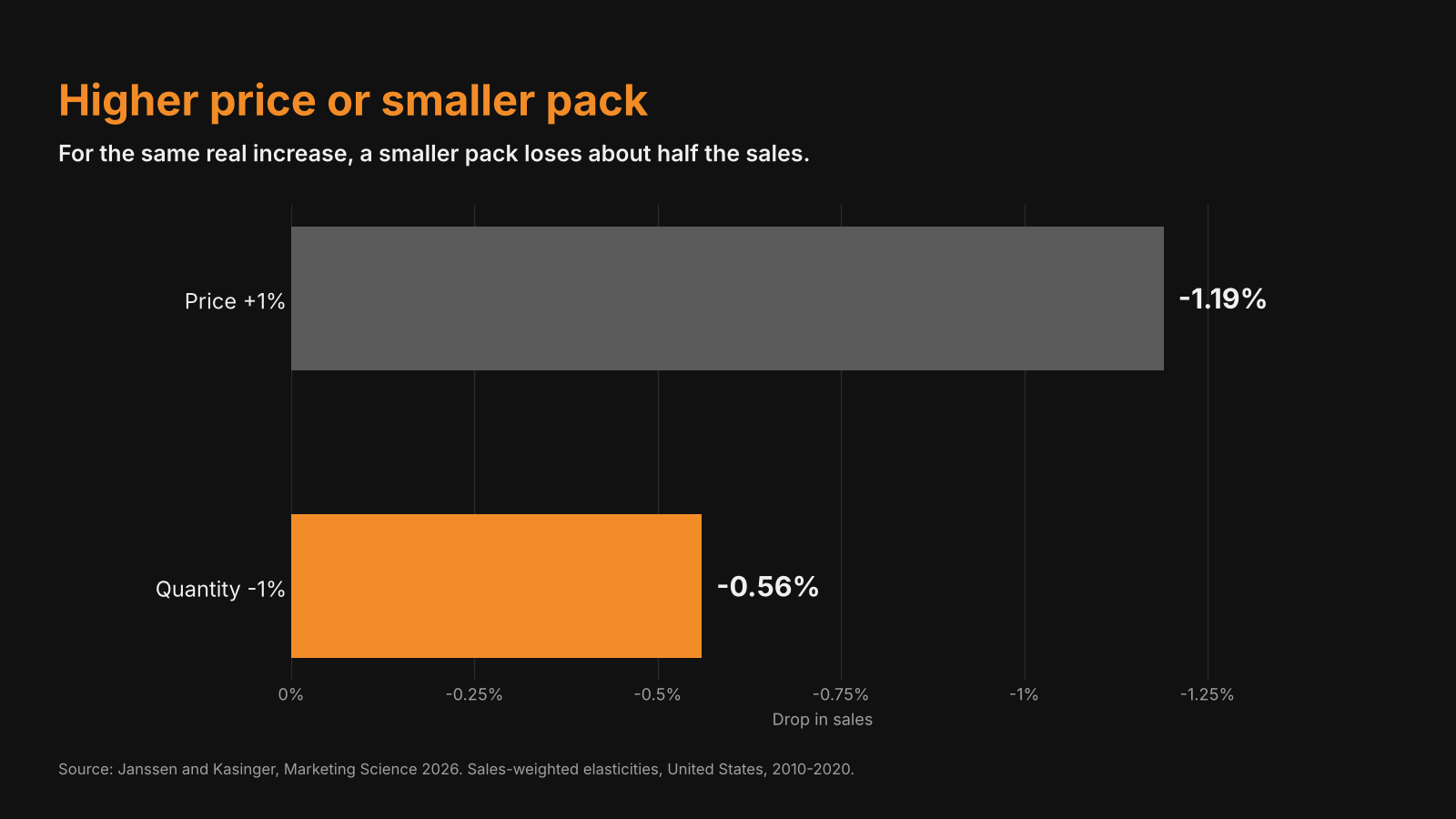
The Marketing Science study compared two ways of raising the real price of a product. When the price goes up by 1%, sales fall by 1.19%. When the quantity goes down by 1%, they fall by only 0.56%. In practice, a smaller pack loses about half the sales a higher price tag would. For products that have already been downsized, the reaction is close to zero.
The explanation is attention. In a Purdue University survey of 1,200 US consumers, 82% often or always check the price before buying, but only 51% look at the unit price and 44% at the weight. According to the study's authors (INFORMS release), many shoppers end up buying an extra pack after a size cut, and spend more overall.
So far the numbers seem to add up. The trouble starts when people notice.
Does shrinkflation pay off for brands? The trust bill
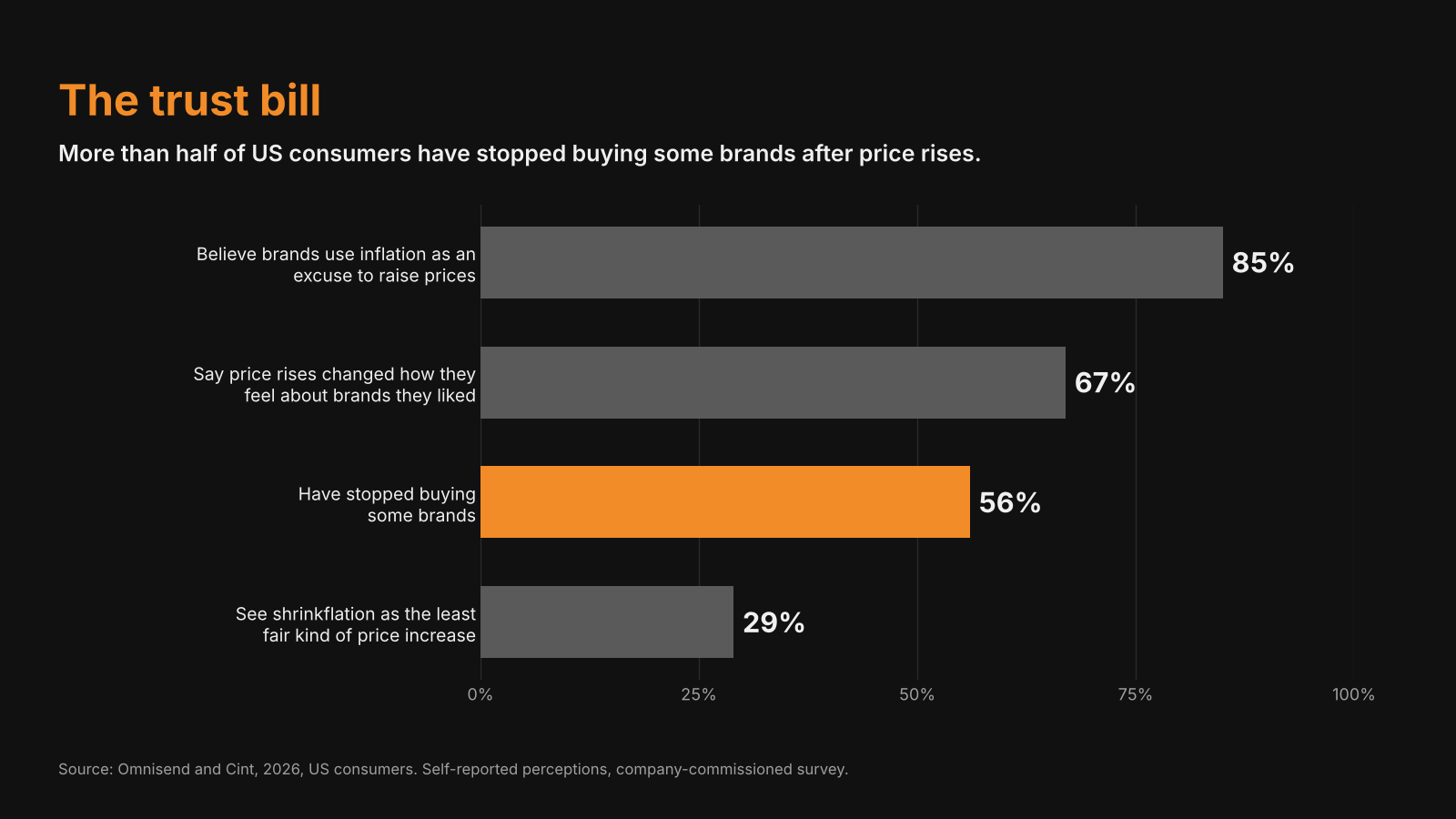
When a cut gets noticed, the brand takes the hit. In a 2026 Omnisend survey run by Cint among more than 4,000 consumers in the US, UK, Canada and Australia, 85% of Americans said brands and retailers use inflation as an excuse to raise prices more than they need to. Two in three said price rises have changed how they feel about brands they used to like, and 56% have stopped buying some of them. Almost three in ten see shrinkflation as the least fair kind of price increase.
The mood is similar elsewhere. In New Zealand, 72% of people surveyed by Consumer NZ in 2025 had noticed shrinkflation, and 78% think supermarkets are not transparent about it.
These are self-reported perceptions, and the Omnisend survey was commissioned by a company. They still show where the risk moves: the Marketing Science study tracks sales over the following year, while trust erodes slowly and is hard to win back. And transparency is exactly where regulators are now moving.
What the rules say in Europe
France moved first. Since 1 July 2024, stores larger than 400 m² must flag on the shelf, for two months, products whose quantity has fallen while the price per kilo has risen, for both branded and private label products.
In Italy the road was longer. The 2023 annual competition law (law 193/2024) added article 15-bis to the Consumer Code, which in its first version required a label on the pack for six months. After the European Commission opened an infringement procedure in March 2025, the label was dropped. Since 15 July 2026, producers must tell distributors and stores about the cut and the resulting rise in unit price, and stores must inform shoppers for three months, online too. The rule does not apply when the pack shrinks together with a reformulation that improves the product. The Italian ministry for business, MIMIT, has published an FAQ; for your own case, get legal advice.
For a brand, shrinking quietly is becoming less and less of an option. The real choice is how to do it, and whether to do it at all.
What a brand can do instead of shrinking quietly
- Run the numbers by customer segment. Some customers check the unit price and some don't. The same cut can go unnoticed by one group and drive away your most loyal buyers. A data-driven segmentation tells you which effect weighs more.
- Say it before the shelf does. In France and Italy the rules already require disclosure. Explaining the choice in the brand's own words costs less than having a supermarket sign explain it for you.
- Give people a choice. A clearly labelled smaller pack at a lower price, next to the usual one, lets the customer decide.
- Be careful with the recipe. Cheaper ingredients at the same weight change the product experience, which is the reason people buy it again.
- Watch who sits next to you on the shelf. When a brand loses trust, the nearest alternative is often private label.
Frequently asked questions
What is shrinkflation?
It is cutting the amount of product in a pack while the price stays the same or rises.
What is the difference between shrinkflation and skimpflation?
With shrinkflation the quantity falls. With skimpflation weight and price stay the same and the recipe uses cheaper ingredients.
What are some examples of shrinkflation?
In Italy Pringles Original went from 200 g to 175 g, Toblerone bars in the UK went from 400 g to 360 g and from 170 g to 150 g in 2016, and Andrex rolls went from 280 to 221 sheets.
Is shrinkflation legal in Europe?
Yes, but France and Italy now require it to be disclosed. In Italy, since 15 July 2026, producers inform stores and stores inform shoppers for three months.
How can you spot shrinkflation?
By checking the unit price and the weight. According to a Purdue University survey, only about half of shoppers do so.
About the author

Leonardo Bastreghi
With a background in Communication Sciences and a Master in Food and Wine Business from Luiss Business School, Leonardo combines brand storytelling with a business view of the food and hospitality industries. Born in Montepulciano, he grew up among the vineyards of Vino Nobile.
Other sources
- Janssen and Kasinger, «Shrinkflation and Consumer Demand», Marketing Science 2026
- INFORMS, press release on the Marketing Science study
- ONS, How many of our products are getting smaller?
- Quotidiano.net, Istat data quoted by Unione Nazionale Consumatori
- Dequo, Italy's new shrinkflation rules and Codacons estimates
- Yorkshire Post, Toblerone changes shape (2016)
- Consumerist, Andrex rolls and the ONS study (2017)
- Money.it, shrinkflation examples in Italy (2026)
- Purdue University, Consumer Food Insights 2024
- Abasto, Omnisend and Cint survey 2026
- Consumer NZ, grocery survey 2025
- Service-public.fr, France's shrinkflation disclosure rule
- MIMIT, FAQ on pack downsizing in Italy
- Food Affairs, shrinkflation and skimpflation (23/11/2026)